Will Anthropic’s valuation hit __ by December 31?
The conditions, incentives and evidence that could shape the answer.Which Anthropic valuation are we talking about?
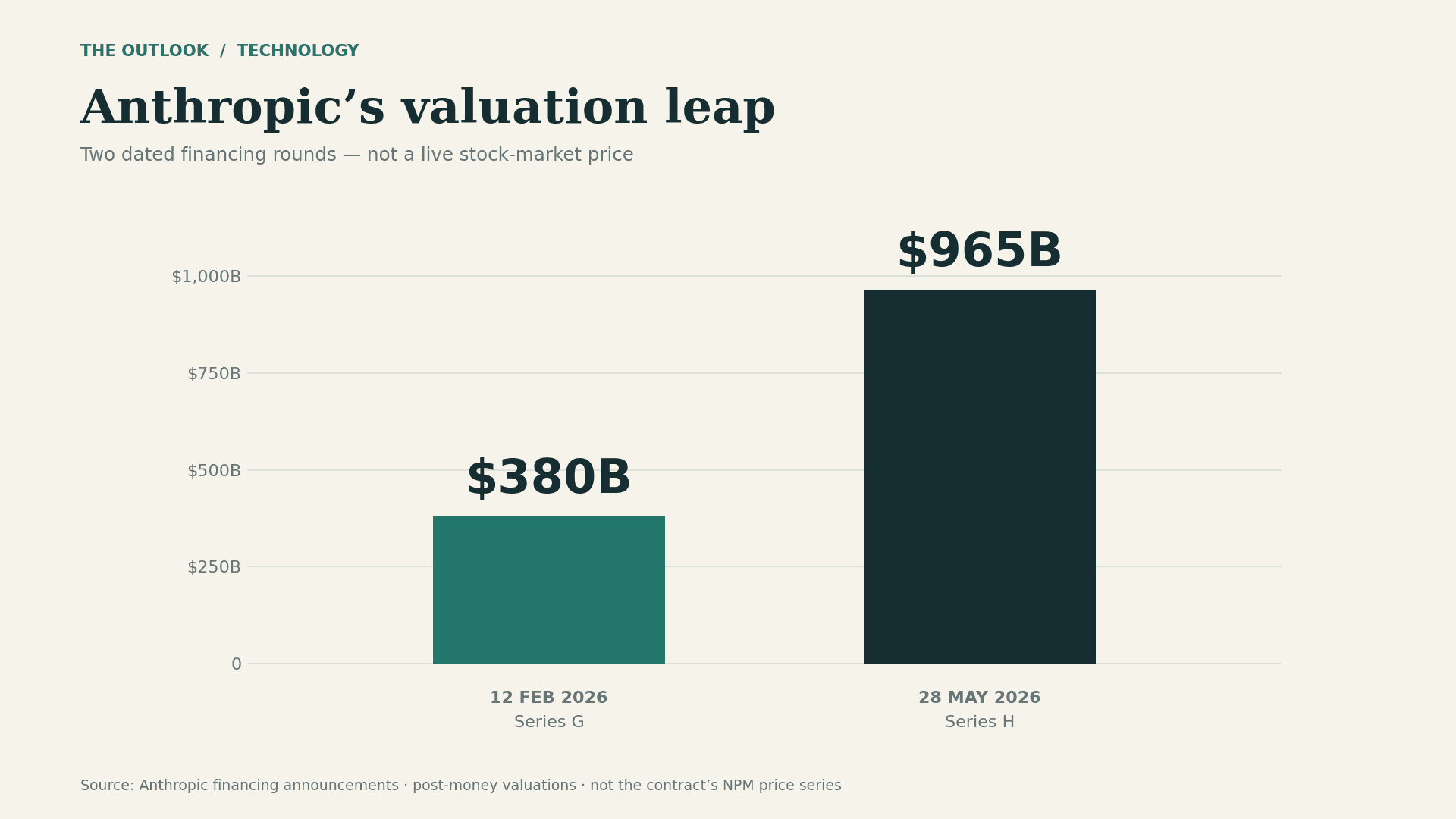
Anthropic’s May 28, 2026 announcement placed its Series H post-money valuation at $965 billion after a $65 billion round. Its February Series G announcement had specified $380 billion. Those are two dated private financing benchmarks, and neither should be presented as a live exchange price on October 4. [3][5]
The distinction answers a common search question more honestly than a single enormous number. A funding valuation describes a transaction under particular terms. A secondary-market estimate asks what existing shares may be worth using different observations. An eventual public capitalization would depend on a traded price and the relevant share count. Calling all three simply Anthropic’s value hides the measurement choice.
Nasdaq Private Market says its NPM Price combines inputs including financing rounds, secondary trades, bids and offers, 409A valuations and fund marks. That makes it a modeled price estimate rather than a guarantee that every shareholder can sell an entire holding at the displayed value. The market examined here explicitly chooses that provider’s series while the company remains private. [4][2]
The business case needs more than impressive growth
Anthropic’s February financing announcement reported $14 billion of run-rate revenue and described rapid adoption of Claude Code and enterprise products. A run rate annualizes a recent pace; it is not the same thing as revenue recognized over a completed year. The distinction matters most when a business is growing quickly, because the headline can outrun the historical financial statements. [5]
Our interpretation is that a higher valuation could be supported by customers expanding usage, paying for durable workflow benefits and returning after the novelty wears off. The useful test is whether those gains can be delivered at attractive economics. More usage is not enough if serving it absorbs an equally large or larger amount of incremental spending.
Infrastructure is a documented constraint, not an invented hidden variable. Anthropic’s April Amazon announcement described additional compute capacity and acknowledged reliability pressure from rapid growth. A signed capacity agreement can address a bottleneck, but it also leaves questions about deployment timing, utilization and the financial obligations needed to support expansion. [6]
This creates a two-sided valuation question. Limited capacity can prevent a company from meeting demand. Building ahead of demand can leave it with underused resources. Neither outcome follows automatically from the announcement. What would distinguish them is evidence on delivered capacity, actual customer usage and the cost of supporting that usage.
What would have to be true for a much higher value?
A $2.5 trillion value is about 2.59 times the May $965 billion benchmark. That arithmetic illustrates the scale of the proposed threshold; it is not a measured investment return, because the financing benchmark and the contract’s accepted series need not value identical rights on identical dates. [3][2]
In a stronger scenario, commercial results support expectations for a larger, durable business while execution makes infrastructure spending more productive. Investors could then accept a higher value for the economic claim they are buying. In a weaker scenario, slower adoption, pricing pressure or heavier cash requirements could offset technical progress. These are conditional business mechanisms, not claims about undisclosed results.
A third scenario is that the valuation measure changes because the company goes public. The contract then permits defined IPO or direct-listing values and regular-hours public capitalization. That introduces a new price-setting environment without guaranteeing that the value moves upward. The opening excitement of a listing and the value investors accept afterward are separate observations. [2]
The evidence hierarchy is therefore important. An official financing announcement establishes financing terms. A product release establishes a release. Customer and financial disclosures can inform the business case. None should be silently substituted for the exact valuation series that answers the threshold question.
How to read the $2.5 trillion market without confusing it with a forecast
Our October 4, 2026, 09:57 UTC snapshot quoted the $2.5 trillion upward condition at 44.5%. That is a traded expectation about a qualifying crossing, not an estimate that Anthropic is currently worth $2.5 trillion or a forecast of its closing value on December 31. [1]
The NPM observations specified in the rules cover eligible dates through December 31, 2026. Following a qualifying listing, the allowed public-market calculation uses the specified trading prices and outstanding common shares. Acquisition consideration is excluded, and the rules distinguish ordinary later revisions from clear-error corrections. Missing end-period data can extend the resolution process into early January. [2]
For readers following the company, the next substantive updates are verifiable operating disclosures, completed financing terms and, if it lists, public share information. For readers following this particular contract, the accepted dated valuation observation is additionally decisive. Keeping those two questions separate makes it possible to understand a strong company without endorsing every price attached to it.
WEIGH BOTH SIDES
What would change the outlook?
Anthropic reaches the qualifying $2.5 trillion valuation threshold by December 31, 2026
Quoted market evidence: Oct 4, 2026, 09:57 UTC. The live market panel may show a newer observation.
The next signals to watch
The $2.5 trillion condition was 44.5% at October 4, 2026, 09:57 UTC. This is a crossing expectation, not a current company valuation or demonstrated trading advantage. [1]
Understand the business economics, then check whether the accepted measurement actually meets the target.
A FEW GOOD QUESTIONS
What else should you know?
What is Anthropic’s valuation?
Its May 2026 funding announcement specified $965 billion post-money. That dated financing value is different from a current secondary-market estimate or a future public capitalization. [3]
Does a new funding round automatically settle this market?
No. The rules primarily use NPM’s reported series while Anthropic is private, with specified public-market methods after a listing. A financing headline alone is not a substitute. [2]
Does Anthropic have to finish 2026 above $2.5 trillion?
No. The upward condition concerns a qualifying threshold observation during the allowed period, not only a December 31 closing value. The exact data and publication rules still apply. [2]
CHECK THE EVIDENCE
Sources & further reading
- Polymarket: Will Anthropic’s valuation hit __ by December 31? — observed event and constituent prices ↗polymarket.com
- Polymarket: Will Anthropic's valuation hit (HIGH) $2.5T by December 31? — exact resolution rules ↗polymarket.com
- Anthropic: $65 billion Series H at $965 billion post-money, May 28, 2026 ↗anthropic.com
- Nasdaq Private Market: NPM Price methodology ↗nasdaqprivatemarket.com
- Anthropic: $30 billion Series G at $380 billion post-money, February 12, 2026 ↗anthropic.com
- Anthropic: Amazon compute collaboration, April 2026 ↗anthropic.com
Published . AI-assisted, source-linked analysis. We distinguish evidence from interpretation; this article does not establish a trading edge. How we work →