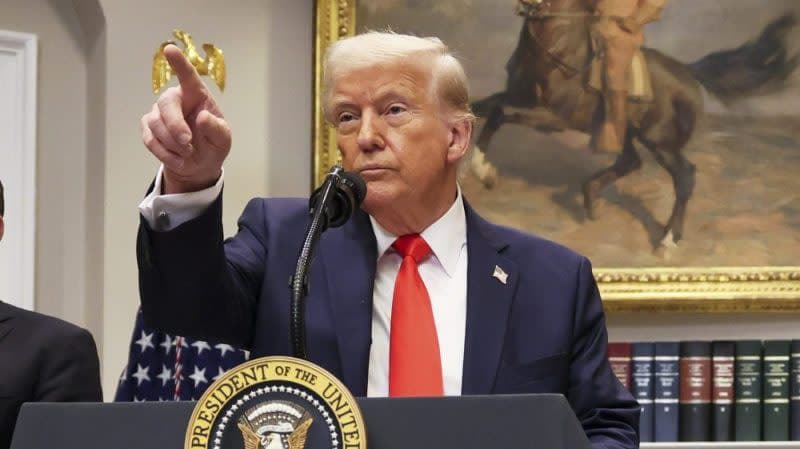
Trump out as President before 2027?
The conditions, incentives and evidence that could shape the answer.What would actually change who holds presidential power?
The White House’s official administration page identifies Donald Trump as the president. That is the current starting point for this review, rather than a conclusion drawn from a prediction-market price. A resignation, a constitutional removal and an acting-president arrangement are different events. Understanding which one a report describes is necessary before deciding whether it means Trump has left office. [1][4]
Political criticism is not a completed institutional action. A demand from a commentator, a legislator proposing articles of impeachment and a formal vote each represent different stages. Readers should ask for the underlying document, the body authorized to act and the recorded decision. This article explains the mechanisms; it does not assert that the reviewed material establishes a pending departure or speculate about anyone’s medical condition.
Why impeachment alone does not remove a president
The House of Representatives can impeach by a simple majority. The Senate then tries the case, with the chief justice presiding over a presidential trial; conviction requires two-thirds of senators present. Removal follows conviction. The threshold therefore differs both from an ordinary House majority and from a simplistic assumption that every Senate proceeding needs exactly 67 votes regardless of attendance. [2]
Our interpretation is that the decisive evidence would be recorded votes and demonstrated support for the required constitutional steps, not the number of times the word impeachment appears in headlines. A serious investigation may change the political outlook without having completed removal. The substantive allegations must also be assessed on their evidence: their inclusion in a proposal does not establish their truth or guarantee how either chamber will vote.
What the 25th Amendment does, and why timing matters
Section 3 allows a president to declare an inability temporarily, with the vice president exercising powers as acting president. Section 4 starts with the vice president and a majority of the principal executive-department officers, or another body Congress establishes, declaring inability. If the president contests it, the amendment provides a further process in which two-thirds of both Houses must sustain the inability determination for the acting arrangement to continue. This is a distinct route from impeachment. [4]
The calendar is another constraint. Under the Twentieth Amendment, new congressional terms ordinarily begin on January 3. Thus members elected for new terms in 2026 would ordinarily take those seats in January 2027, after this market’s year-end cutoff. An election changing the next Congress’s composition does not immediately replace the sitting Congress or itself remove a president. Assess any claimed route to departure against the institutions able to act during the actual contract window. [3]
How the Trump departure market draws its boundary
The October 4, 09:57 UTC snapshot put Yes at 3.55%. That was a traded forecast for a narrowly defined event before year-end, not evidence of secret plans or a quantified finding about Trump’s health. A low quote can coexist with intense public discussion because attention to an issue and completion of its constitutional mechanism are different things. [5]
The contract explicitly excludes impeachment without removal and temporary transfers under Section 3 or an unsustained Section 4 invocation. It expressly includes a Section 4 inability determination upheld by two-thirds of both Houses, even though the constitutional term for the vice president exercising those powers is acting president. A resignation or removal announcement before the deadline also counts even if effective later. Those written exceptions matter more than a casual reading of “out.” [4][6]
WEIGH BOTH SIDES
What would change the outlook?
A qualifying Trump departure or announcement by December 31, 2026, including the contract’s sustained Section 4 condition. [6]
Quoted market evidence: Oct 4, 2026, 09:57 UTC. The live market panel may show a newer observation.
A formal qualifying resignation/removal announcement, completed removal or the specified sustained inability determination would support Yes.
Continued service, an impeachment without conviction or a temporary power transfer would not satisfy the written rule. [6]
The next signals to watch
The preserved 3.55% quote describes this deadline and rule set; it does not verify a rumor. [5]
Identify the legal event and its timing before interpreting a political headline as a change of presidency.
A FEW GOOD QUESTIONS
What else should you know?
Would the House impeaching Trump remove him?
No. Removal by the impeachment route requires Senate conviction, with two-thirds of senators present voting to convict. [2]
Would a temporary transfer to Vice President Vance count?
No. The contract excludes temporary transfers and specifically defines the sustained Section 4 case that can qualify. [6]
CHECK THE EVIDENCE
Sources & further reading
- White House: Donald Trump, serving president ↗whitehouse.gov
- US Senate: impeachment authority, trial and conviction requirements ↗senate.gov
- National Archives: Twentieth and Twenty-Fifth Amendment text ↗archives.gov
- National Archives / Reagan Library: Twenty-Fifth Amendment history and process ↗reagan.blogs.archives.gov
- Polymarket: Trump out as president before 2027 ↗polymarket.com
- Polymarket: permanent departure, temporary-transfer exclusions and Section 4 rule ↗polymarket.com
Published . AI-assisted, source-linked analysis. We distinguish evidence from interpretation; this article does not establish a trading edge. How we work →