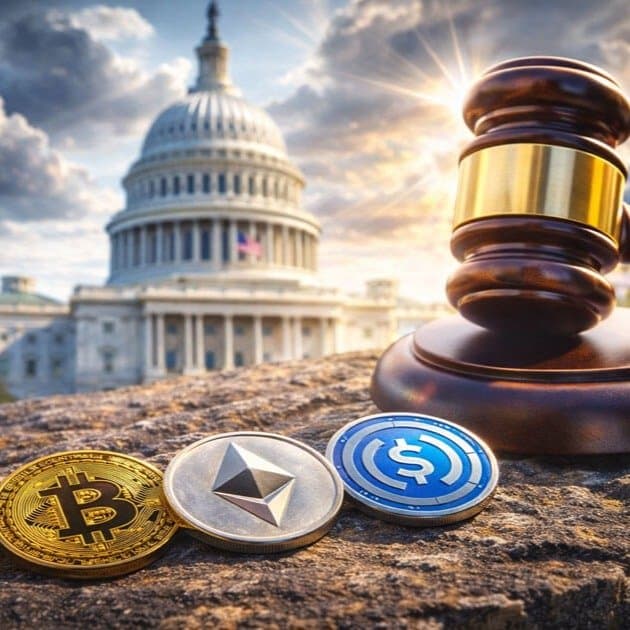
Clarity Act (H.R.3633) signed into law in 2026?
The conditions, incentives and evidence that could shape the answer.Did the CLARITY Act pass? The current answer
The answer depends on which legislative step the headline means. The House of Representatives passed H.R. 3633 on July 17, 2025, by 294 votes to 134. [4] That is a completed House vote, not proof that the measure became federal law. Readers encountering an old passage headline alongside a new failure headline may therefore be seeing two accurate accounts of different stages.
The important later record is the Senate vote of September 15, 2026. Cloture on the motion to proceed failed, with 49 senators voting yes, 50 no and one not voting. [3] In plain language, this attempt to overcome the procedural barrier to taking up the bill did not succeed. It was not a final vote on passing the legislation.
That distinction cuts both ways. Calling the bill enacted would overstate what happened. Saying the September vote conclusively prevents every future attempt would also go beyond the record. The useful starting point, as of this review, is an unfinished legislative process with a demonstrated Senate obstacle. Any claim that the position has changed should identify the subsequent official action, its date and what that action actually accomplished.
What the bill is trying to change
The Senate-reported text describes a framework for SEC and Commodity Futures Trading Commission regulation of digital commodities. Its title also includes restrictions concerning central bank digital currency. [5] This is broader than a single announcement about whether one trading platform or token can operate. The relevant questions concern the legal categories, duties and regulatory powers that the enacted text would establish.
For a general reader, the economic issue is how uncertainty gets allocated. Businesses want to understand which requirements apply before committing resources. Customers need to know what protections accompany access to a product. Our analysis is that agreement on the word clarity does not necessarily mean agreement on the obligations that produce it. A rule can be clearer while imposing costs or restrictions some participants oppose.
Version control matters because the bill is not a frozen document. The GovInfo record reviewed here is the version reported in the Senate on June 1, 2026, with an amendment. [5] A summary of an earlier House version should not automatically be treated as a description of every later proposal. When a headline announces a compromise, the practical test is whether the actual text changed and whether the relevant lawmakers accepted that text.
What can happen while legislation remains unfinished
Regulation can develop through more than one route. On September 17, SEC Chair Paul Atkins acknowledged that Congress had not advanced CLARITY and described the agency’s Innovation Exemption. The statement sets out temporary, conditional relief for certain venues and liquidity providers involved in tokenized stocks, while retaining anti-fraud and anti-manipulation requirements. [6] That is a specific regulatory action under existing authority, not a replacement name for an enacted statute.
This creates two different stories to follow. One concerns whether Congress can complete this bill. The other concerns what regulators permit, require or enforce while that process remains unresolved. A company might regard a limited exemption as commercially significant even while a prediction market becomes less optimistic about legislation. Those reactions would not necessarily contradict each other because they refer to different outcomes.
A stronger case for eventual passage would require evidence that the obstacle revealed by the Senate vote is being addressed: a viable revised text, sufficient support for the necessary procedural steps and actual movement on the calendar. These are conditions to investigate, not claims of a deal already reached. A weaker case would involve repeated announcements with no completed steps, or changes that still leave the chambers supporting incompatible versions.
The milestones that would change the answer
Start with the exact question on any new roll call. A vote to end debate, a vote on an amendment and a vote on final passage do different things. The Senate explains cloture as a way to limit debate; for ordinary legislation its usual threshold is three-fifths, normally 60 senators. [7] Counting every favorable vote as passage creates a misleading picture of progress.
Next, look for agreement between the chambers. The Senate’s guide identifies an enrolled bill as the final copy passed in identical form by both houses and sent forward for signatures. [8] That document is stronger evidence of completed congressional agreement than an earlier committee draft or a lawmaker’s description of a possible compromise.
The Polymarket contract adds a particular deadline: H.R. 3633 must pass both chambers and receive the president’s signature by December 31, 2026 at 11:59 p.m. ET. [2] Its price was 5% in the October 4, 09:57 UTC snapshot. [1] That dated quote summarizes trading around a narrow condition; it does not determine what the law is. The reader’s most useful update is the next verified institutional step, with its scope made explicit.
WEIGH BOTH SIDES
What would change the outlook?
H.R. 3633 passes both chambers and is signed into law by December 31, 2026
Quoted market evidence: Oct 4, 2026, 09:57 UTC. The live market panel may show a newer observation.
The next signals to watch
The enactment condition was quoted at 5% in the October 4, 2026, 09:57 UTC snapshot. A possible legislative route does not establish that this price is wrong, and the quote is not an official assessment. [1]
Track completed legislative steps for this bill separately from broader developments in U.S. crypto regulation.
A FEW GOOD QUESTIONS
What else should you know?
Did the CLARITY Act pass?
It passed the House in July 2025. The Senate failed to invoke cloture on the motion to proceed in September 2026; the reviewed records do not establish enactment. [3][4]
Is the CLARITY Act dead after the Senate vote?
The failed vote shows that one attempt to advance it did not succeed. It does not, by itself, prove no later route exists. A renewed effort still needs documented legislative progress. [3][7]
Can the SEC change crypto rules without the CLARITY Act?
The SEC has acted within existing statutory authority: its September 17 statement describes temporary, conditional relief for certain tokenized-stock venues and providers. That is narrower than enactment of this bill. [6]
CHECK THE EVIDENCE
Sources & further reading
- Polymarket: Clarity Act (H.R.3633) signed into law in 2026? — observed event and constituent prices ↗polymarket.com
- Polymarket: Clarity Act (H.R.3633) signed into law in 2026? — exact resolution rules ↗polymarket.com
- U.S. Senate: H.R. 3633 cloture vote, September 15, 2026 ↗senate.gov
- House Clerk: H.R. 3633 passage, July 17, 2025, roll call 199 ↗clerk.house.gov
- GovInfo: H.R. 3633 as reported in the Senate, June 1, 2026 ↗govinfo.gov
- SEC: Statement on the Innovation Exemption, September 17, 2026 ↗sec.gov
- U.S. Senate: Filibusters and cloture explained ↗senate.gov
- U.S. Senate: Key to versions of printed legislation ↗senate.gov
Published . AI-assisted, source-linked analysis. We distinguish evidence from interpretation; this article does not establish a trading edge. How we work →